Welcome to our Community Blog

Welcome to our Community Blog
Real Estate Title Company Blog

Wednesday, November 25, 2015

Happy Thanksgiving from Getz Law and Getz Title

We at Getz Law Office, LLC and Getz Title Group, LLC wish you a Happy and Peaceful Thanksgiving spent with family and friends.

- Stewart, Gretchen, Lisa, Tina and Linda

Friday, February 13, 2015

Getz Law Office shares information on planning for your digital afterlife

Clients often ask what will happen to their social media and other online accounts after their death.  Below is a good article from npr.org on recent developments in this area.

From Facebook To A Virtual You: Planning Your Digital Afterlife


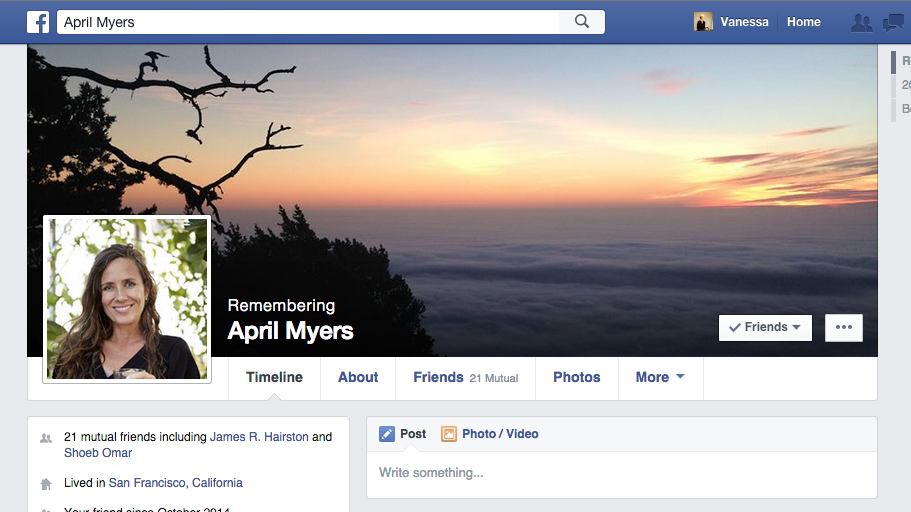
Facebook is adding a "legacy contact" feature to allow selected relatives or friends to manage the account of the user after they die.Facebook is adding a "legacy contact" feature to allow selected relatives or friends to manage the account of the user after they die.
                   
Social Media platforms are getting closer to answering the question: What happens to our online accounts after we die? Facebook, Google and other popular services are offering more control over how we are remembered online. And at least one startup is looking at ways of using artificial intelligence to keep us alive virtually — long after we're gone.
Facebook announced Thursday that it is adding a new "legacy contact" feature — think of it as an emergency contact for your account in the case of death. As before, Facebook says the account of a deceased user will change to a "memorialized" status. But now, depending on the preferences the user has selected while they've living, Facebook says a family member or friend can:
  • "Write a post to display at the top of the memorialized Timeline (for example, to announce a memorial service or share a special message)
  • "Respond to new friend requests from family members and friends who were not yet connected on Facebook
  • "Update the profile picture and cover photo"
Previously, Facebook has been strict on refusing account access to family members of the deceased.
This announcement follows several other moves from companies attempting to grapple with the legal and emotional challenges of the digital afterlife:
  • Google introduced the Inactive Account Manager tool to protect the privacy of the deceased.
  • Yahoo Ending from Yahoo Japan also allows the living to prepare by crafting posthumous emails, canceling subscriptions and curating videos and photos to share when they're gone.
  • We've already seen the emergence of QR codes on headstones, linking visitors to personalized Web pages for the deceased.
It's not just a solution for confidentiality and the grieving process. These new models satisfy our fears of dying, says University of Arizona psychologist David Sbarra. "For centuries, humans have tried to battle immortality," he says.
"Culture is a manifestation of peoples' efforts to symbolically make themselves permanent," he says. "So we have technological advancements that can then ward off fears of our own mortality."
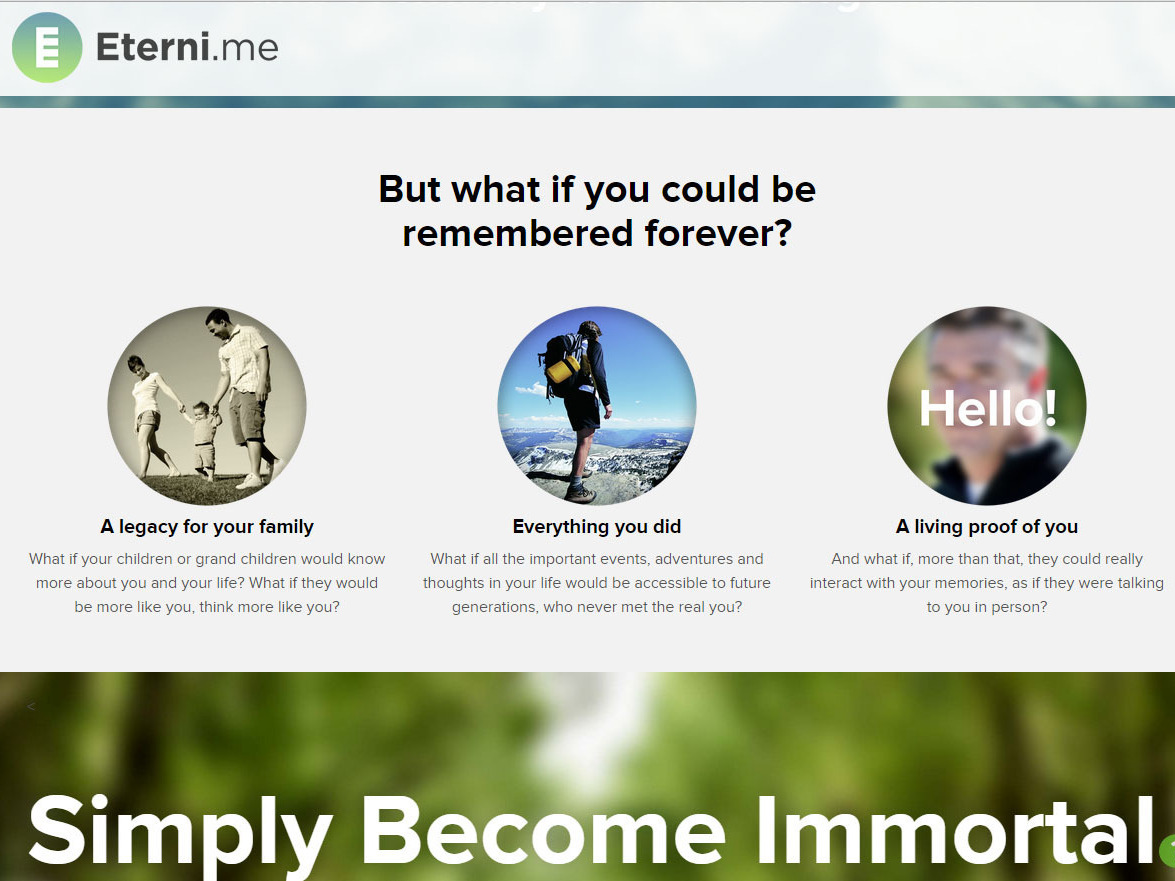
A startup called Eterni.me offers an ambitious and perhaps creepy experience to quell this universal anxiety. It lets people continue to communicate with a digital replica of their loved ones after they die. Eterni.me plans to let you curate your own immortal avatar while you're living and choose who you make it accessible to when you pass on.
"We all pass away sooner or later, leaving only a few memories behind for family, friends and humanity—and eventually we are all forgotten," reads the website's landing page. "But what if you could be remembered forever?"
Eterni.me says it plans to create a digital replica of a loved one from past social media postings, photos and other data.Eterni.me says it plans to create a digital replica of a loved one from past social media postings, photos and other data.Though the website is sparse, Eterni.me's concept has already evolved from a chatbot-navigated site to a 3-D digital avatar that mimics your personality. The startup's motto: "Simply Become Immortal."
The website adds:
"Eterni.me collects almost everything that you create during your lifetime, and processes this huge amount of information using complex Artificial Intelligence algorithms.
"Then it generates a virtual YOU, an avatar that emulates your personality and can interact with, and offer information and advice to your family and friends, even after you pass away."
Early reactions called it creepy and likened the concept to Black Mirror, the popular British TV series set in a dystopian tech-driven future. One episode revolves around a widow resorting to a service similar to what Eterni.me promises. Fragile with grief, she turns to an online service that connects her with her late husband through instant messaging, phone calls — and more.
  
But Eterni.me doesn't see this as simply science fiction. The company wants to make virtual immortality a reality.
As co-founder Marius Ursache told The New Yorker last year, Eterni.me launched early to gauge public interest:
The company plans to store data from Facebook, Twitter, e-mail, photos, video, location information, and even Google Glass and Fitbit devices. While you are living, you can curate and add to this material; you can also choose privacy settings and determine what information you want stored and made public. Eterni.me then allows you to create a list of people who will be contacted and given access to your account in the case of death, giving your descendants quick and easy access to that Instagram pic of your latte or a detailed history of your Facebook pokes.
The service's defining feature is a 3-D digital avatar, designed to look and sound like you, whose job will be to emulate your personality and dish out bits of information to friends and family taken from a database of stored information. A user will be encouraged to "train" its avatar, through daily interactions, in order to improve its vocabulary and conversational skills. Eterni.me's co-founder, Marius Ursache, thinks of it as a more advanced version of Siri, who, ten or fifteen years from now, will be able to "respond to questions more naturally, and learn from every conversation you have with her."
Ursache said he plans to bring on a psychologist to address the more sensitive issues. As The New Yorker reported:
[Ursache] describes Eterni.me more as a library of material. 'The avatar acts as a librarian, helping users make sense of the stored information,' he said. 'We're not trying to replace the person who died.' "
Ursache tells NPR the company plans to launch a pilot with 100 users in April and expand it to more users throughout 2015.
Emma Bowman is an intern with NPR Digital News.

Friday, January 23, 2015

Getz Law Office & Getz Title Group share tech advice

Getz Law Office, LLC and Getz Title Group, LLC share the reminder below to update your passwords regularly for online security.

                
  • Need a Real Sponsor here

’123456′ Again: The Most Popular Passwords Aren’t Changing

Reuters
This is not a reprinted mistake: The most commonly used password in 2014 was “123456,” a security company says.
Despite the high-profile hacking attacks last year, people are still using passwords that security analysts say should have been in the dustbin years ago. Both “123456″ and “password” have been the top two passwords since security-app provider SplashData began measuring the most frequently used passwords in 2011.
Here’s how the top 10 passwords have changed over time, according to SplashData.

SplashData compiled 3.3 million leaked passwords that were posted online by hackers either looking to share the information or prove that they could, SplashData CEO Morgan Slain said. Most of the data came from people in North America and Western Europe. Fortunately, Slain said, the top 25 passwords only make up 2.2% of all passwords, down from about 6% when the list was first compiled years ago.
A good password should be difficult to crack, with a combinations of upper- and lower-case letters, numbers and special characters — definitely not the word “password.” It should be unique to each site, but if it’s too difficult to manage multiple passwords, a number of third-party password managers can help. Here’s Personal Tech columnist Geoffrey Fowler’s latest update.
Copyright 2015 Dow Jones & Company, Inc. All Rights Reserved
This copy is for your personal, non-commercial use only. Distribution and use of this material are governed by our Subscriber Agreement and by copyright law. For non-personal use or to order multiple copies, please contact Dow Jones Reprints at 1-800-843-00081-800-843-0008 or visit
www.djreprints.com

Friday, January 9, 2015

Getz Law Office can assist with planning for increased Maryland estate tax exemption


Getz Law Office can assist you with ensuring your estate plan is up to date


As of January 1, 2015 the Maryland estate tax exemption amount increased from $1 million to $1.5 million.  This means that the first $1.5 million of your estate can pass to your legatees or heirs tax free.  In addition, under the new law, the Maryland exemption amount is scheduled to continue to increase as follows until it is the same as the federal estate tax exemption amount:
     2015 - $1.5 million
     2016 - $2 million
     2017 - $3 million
     2018 - $4 million
     2019 – same as federal exemption amount
As of January 1, 2015, the federal estate tax exemption amount was increased to $5.43 million and increases annually for inflation.  In addition, with the federal portability laws that allow a married couple to share any unused federal estate tax exemption, there are other planning opportunities that can be used to minimize or avoid federal estate tax.
If you are interested in reviewing or updating your current estate plan please contact us.   
 

Thursday, January 8, 2015

Getz Title Group shares White House plan to save home buyers money

President Obama has announced a new plan to help home buyers with FHA loans to save hundreds of dollars.  If you are planning to refinance your home this year please contact Getz Title Group.


Obama announces plan that could save home buyers hundreds of dollars a year

The White House announced Wednesday that the Federal Housing Administration will significantly lower the fees it charges borrowers, a move designed to save individual home buyers hundreds of dollars annually and help jump-start the housing market.

The “annual premiums” on FHA loans, an especially popular source of financing for first-time home buyers, have increased five times since 2010. They jumped from .55 percent of a loan’s value to 1.35 percent. Those fees will drop to .85 percent toward the end of January. The White House projects the lower premiums will entice 250,000 buyers to take out FHA loans in the next three years, and that the new borrowers will save an average of $900 annually.

President Obama plans to highlight the new policy Thursday when he delivers a speech in Phoenix about the housing market, which has been struggling to fully recover in part because mortgage costs are high and lending standards tight. Already, the president’s critics are bashing the decision. They say lowering the fees heightens the chances of a taxpayer-funded bailout for the agency in the future.
In his speech, the president also will call on the FHA to cut red tape and clarify what regulators expect of lenders. Since the housing bust, lenders have been turning away buyers by demanding unusually high credit scores on government-backed loans -- exceeding even the government’s own criteria. The industry says it’s trying to insulate itself from financial penalties. The White House has been alarmed by the reluctance to lend, and it wants the FHA to address the industry’s concerns in the coming months.

The FHA fees issue was debated internally within the administration for days as pressure to reduce the fees kept building. Real estate industry groups – including the Mortgage Bankers Association and the National Association of Realtors – joined a number of housing advocacy groups in urging the FHA to consider reducing the fees. They said the surge has shut out a sizeable chunk of potential buyers, about 234,000 of them last year alone, according to an estimate by the Realtors group.
On Wednesday, as the details of the president’s speech were being finalized, 30 groups sent a letter to the White House to press for lower fees. They said lower-wealth borrowers heavily rely on the FHA’s low-downpayment loans. Many cheered the president’s decision.

“It’s extremely good news for housing, the economy and could not be better timed for the spring market,” said David H. Stevens, the MBA’s chief executive and a former FHA commissioner. “This could ultimately be fundamental to a much stronger U.S. economy in 2015.”

The high fees translated into big bucks for buyers. For instance, a borrower who took out a $200,000 loan paid an annual premium of $91.66 per month before 2010. Now, a borrower who gets a loan of that size pays $225 per month in premiums – a 145 percent increase. Once the lower fees are in place, the monthly payment would drop by $83.

“This is really meaningful for home buyers,” said Brian Chappelle, a banking consultant and former FHA official. “This is the best news for first-time home buyers in years.”
The FHA does not make loans. It insures lenders against losses should the loans go bad, and it uses borrower fees to cover those losses. But in 2013, the agency’s cash reserves fell so low that it had to turn to taxpayers for help for the first time in its 80-year history. It drew $1.7 billion from the Treasury.

The FHA’s finances took a hit after the housing bust, when many borrowers flocked to the agency for financing because credit was tight elsewhere. The agency’s loan volume soared, but so did its default rate. The losses eroded the agency’s cash cushion to a level well below what is required by law. FHA kept raising its fees to beef up its cash reserves.

Its finances have improved. The agency recently announced that its reserves are back in the black for the first time in two years, and an independent audit of the agency’s finances predicts that the agency will reach the level required by law by 2016.

“Our action today is not a return to the past,” Julian Castro, secretary of the Department of Housing and Urban Development, told reporters in a call Wednesday. Castro, who oversees FHA, said the agency is on sound financial footing.

But some lawmakers and housing experts disagree.
Mark Calabria, a director at the Cato Institute, said the policy change would be more acceptable if the FHA were to lower fees only for borrowers, with strong credit scores or hefty downpayments. “It sort of surprises me that they’re going down this route,” Calabria said.

Rep. Jeb Hensarling (R-Tex.) said in a statement Wednesday that “if President Obama follows through on today’s pledge, he will be increasing the likelihood that taxpayers will have to foot the bill for yet another bailout.”

But supporters of the president’s decision say the FHA would eventually attract only the poorest quality borrowers if it keeps its fees too high, and that’s a horrible proposition for taxpayers. “That makes for a mighty expensive and risky business model,” said Jim Parrott, a former White House housing adviser.

Washington Post reporter Greg Jaffe contributed to this report.
 
Dina ElBoghdady covers housing policy for The Washington Post.